Let's look again at the inherent emptiness of awareness (see Lesson 3).
First, remember that the idea of emptiness and the actual experience of emptiness are different. Having an idea of emptiness doesn't create an experience of emptiness. It fills awareness with the idea of emptiness. Any idea is a "something" that can fill awareness. To experience the emptiness itself, you must take a moment to relax, suspend overlays, let go of the sixth consciousness, and just rest in awareness itself. If you do this, awareness is in its base state, which is empty. At the base, awareness is just aware. We also call this pure awareness or Naked Awareness.
Awareness is empty from the start. It begins empty. In other words, that is its native state. Before you think, feel, or otherwise experience anything, there is awareness, but it has nothing in it. It is naturally empty of any views, memories, decisions, preferences and so forth. Even the world. As you begin to perceive, think and feel, awareness fills and attention goes on those things that fill it. Emptiness is always the starting point. It's the base of experience.
Thoughts don't think other thoughts. There is no causal connection between one thought and another (even though it sometimes seems that way). Even when there is a flow of connected thoughts, each thought actually comes into existence independently. Thoughts arise from the empty base. Sometimes it seems that thoughts have causative power over other thoughts, but this is just an illusion. The benefit of knowing this is that you can drop a train of thought at any time and be at original emptiness again. It is a choice we always have.
Most of the time, our thoughts and feelings ARE the reality we live in. We often don’t notice that we are directly experiencing internal representations, and, instead, completely believe that we experience the inherent qualities of an external reality. This makes the experiences quite compelling!
Remember that having a view, opinion, attitude, or decision about anything (including emptiness) isn't what we are after. Emptiness is a primordial, original source state. You don't have to create anything to experience this emptiness because it is already empty from the start. In fact, if you think any thoughts or create anything in your mind to understand this, you move away from the empty state. The thoughts just fill the emptiness with mind stuff and that is where your attention goes, so this is not our intent.
The emptiness-at-the-start practice is incredibly simple: stop adding overlays. Don't analyze the objects your senses bring in, don't get tangled up analyzing your own inner thoughts, and don't let your mind chase memories of the past or fantasies of the future.
When you stop doing those things, the overlays fall away. When the "veil of the intellect" (the sixth consciousness) is removed, you are left with Naked Awareness. It is vast and space-like, filled with an inner luminous clarity, and holds a direct, non-conceptual knowing.
Finally, when you can rest in this thoughtless state, you experience what we call "the base." It is completely neutral—empty in itself, but possessing the infinite capacity for any experience to arise within it, continuously, and without ever altering the base itself.
A Practice
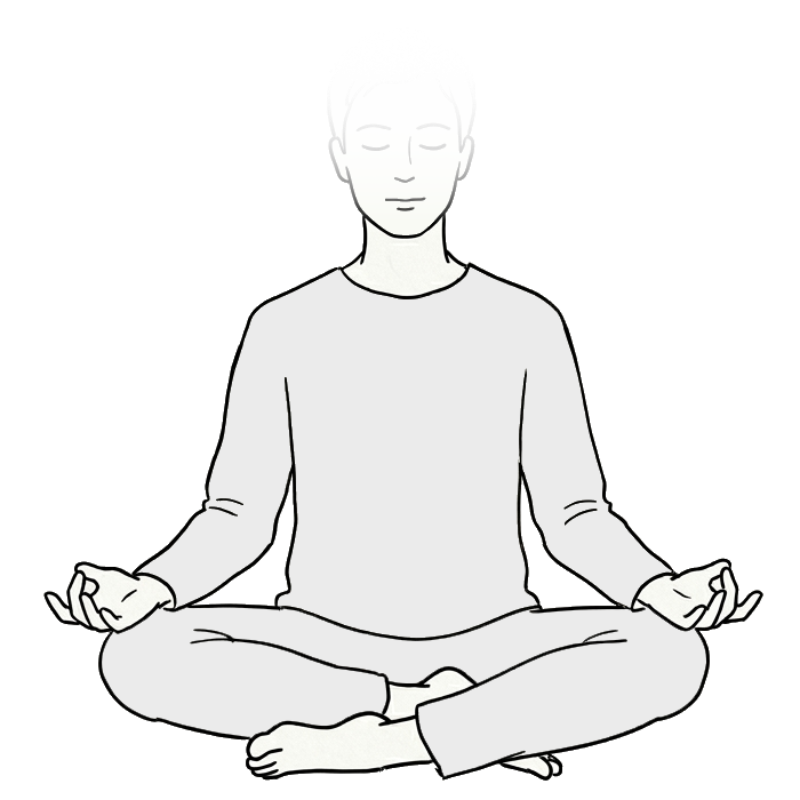
Go where you go to meditate and sit. Let your eyes rest on a simple object in the room, or just let them rest on the space in front of you. Let your eye consciousness take in the visual data, but intentionally turn off your mind's tendency to scrutinize.
- If you catch yourself naming the object, let the label go.
- If you catch yourself evaluating if you like it or dislike it, let the judgment go.
- If you catch yourself looking inward to see "how well you are doing the practice," let that inner analysis go too.
Just cleanly perceive what is there without adding a single comment. Notice the spaciousness that opens up when the intellect stops chewing on reality.
Note that you wouldn’t want to force your mind to be blank or anything like that. It is more like a letting go.
And another practice that goes along with “emptiness from the start”:
A Practice
This practice builds on the previous one. Once you have settled your mind and are no longer chasing thoughts or scrutinizing objects, turn your attention to the empty awareness itself.
Notice that this empty awareness is completely neutral. It isn't happy or sad; it just is. Now, observe how sounds, physical sensations, or even brief thoughts spontaneously pop into existence out of this neutral space.
Realize that this silent, empty awareness is the base—the fertile ground that has the potential to manifest absolutely any experience you will ever have.
Note that the emptiness-at-the-start is not changed or harmed by what fills it (perceptions, thoughts, and feelings). It is untouched because awareness is just the potential for new experiences and that is beyond the experience itself. For most of us, awareness just stays filled up with stuff so we don't experience it in its native state very often.
Bonus: When experienced from the clear, empty space we call the base, every event and meaning unfolding in the present moment feels vividly fresh. The philosopher Alfred North Whitehead called this "ingression of novelty." In Zen, they call it “new mind.” You can experience this directly when awareness rests quietly in the base, perceiving things as they emerge within the subjective field.
Because each moment is born cleanly out of emptiness, it carries a profound sense of originality. This striking freshness of the "now" is one of the great rewards of experiencing life from the base.
To summarize:
- The idea of emptiness and the experience of emptiness are different.
- Attention usually goes to what arises in awareness, thus obscuring the emptiness.
- All perceptions, thoughts, and feelings begin from emptiness.
- Emptiness is not changed by what arises within it.
- Experiences are fresh with novelty when experienced from emptiness.
Dedication to All Beings
If you wish, take a moment now to dedicate any improvement or benefit you got from this lesson to all beings. Do this with an open heart.