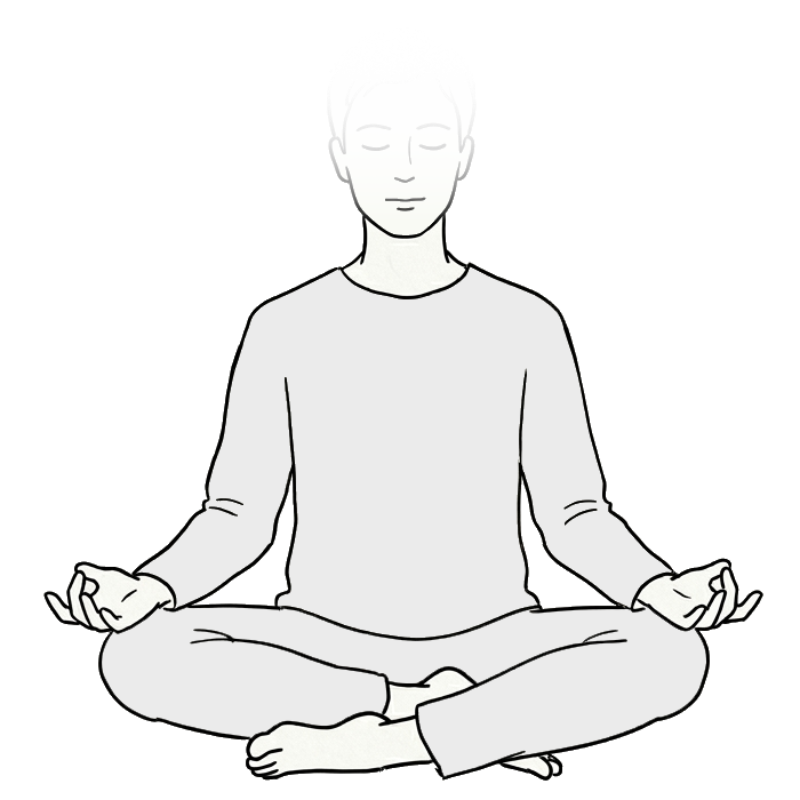
Standing outside of the realm of description is a good practice to help you find your roots in pure awareness.
"Standing outside of the realm of description" means simply that you stay present but don't describe what you are aware of. You don't describe whatever you are aware of with words in your mind (or out loud, for that matter). You are aware of what you are aware of without inventing any dialog, stories, labels, or captions to go with it. Don't evaluate, judge, form opinions, or rehearse what you might say about what you are aware of. Just be aware of the naked feed.
A Practice
Put your attention on an object and experience it outside of the realm of description. Just be nakedly aware of it.
Close your eyes and remember a recent event. Mentally experience the memory of the event as a pure image, with no description.
You actually are always outside the realm of description, so you can approach this practice that way, recognizing the wordlessness of your native state. Often we are not conscious of this, but it is always true anyway.
In Lesson 4, you learned about the sixth consciousness. With this practice, you are de-identifying with the actions of the sixth consciousness. You step outside the domain of the sixth consciousness, and let the cloud of descriptions in your mind dissipate, leaving an open place for Naked Awareness. This gives you the opportunity to directly experience an aspect of the natural emptiness of awareness.
People vary a lot about how much they internally describe what they are aware of. I talked to a person a while back who said he could not even imagine not describing what he was aware of. He didn't know even how to start to do that. I think there are many people who aren't too familiar with being aware while empty of thought. This practice is especially beneficial to them.
This isn't something you do, it is something you stop doing. You just let go of the automatic internal description of what you are aware of. For example, often people judge themselves, especially after they did something that they imagine is wrong or stupid (which we all do at one time or another). To do this practice, you would simply take a moment to consciously not judge.
A Practice
Recall a time when you did something wrong or stupid, something that has some “charge” on it. While recalling it, let go of all 6th consciousness overlays so you are standing outside of the realm of description in relation to that memory. If you can do this, you will notice that the “charge” on the event is gone.
Next, recall a current problem and do the same thing. Notice that if you view it from outside the realm of description, it sort of disappears.
Suppose you always name things. You might be someone who needs to name everything. It is as if you feel you aren't aware of something unless you can name it. This isn't true. You can be aware of something without naming it. In fact, you can know it more intimately if you don't name it because you don't overlay it with concepts and words and all the associations those words connect to. The thing just stands on its own legs within the field of awareness.
Standing outside of the realm of description is a part of being in contemplation. You can't really be in contemplation if you are mentally describing things (or at least, it is difficult). Mentally describing things brings in all sorts of mental and verbal associations, previous experiences, and the like, that make it hard to just directly get the suchness or simple actuality of the thing you are aware of at this moment. Standing outside of the realm of description immediately clears the mind of this material and what remains is a simple state of Naked Awareness, uncluttered by verbal mind. It takes a little practice, that's all.
Your words don't make things what they are. Descriptions aren't even true knowledge of what things are. Descriptions and other overlays do have their place, but it is also good to be able to stand outside of the entire realm of descriptions so that you just nakedly experience what you are experiencing. As you get used to doing this, your describing mind quiets down a bit and there are moments of emptiness, which are refreshing and help you to re-sync to the base.
In Buddha land we can be grounded in a state outside of the process of describing things, at least part of the time. This state should be easily accessible in any situation or circumstance. When something "strong" comes along, we'd like to be sort of transparent to it, letting the energy flow through without getting stuck and causing distress. Not automatically labeling goes a long way towards not getting stuck in things.
"But what about Dyads?" you might ask. When you do a Dyad, you’re asked to describe what comes up in your mind. In the Dyad, the first part is contemplation, so this is where you stand outside the realm of description and just be open to experiencing the truth directly. During that time, you do not chase after thoughts about what is real and what isn't, or about what is the true self and what isn't, or about what has occurred that is you or not you. You stand outside of the whole realm of description and just experience directly, without seeking the concept or words that describe what you are experiencing.
Sometimes you have to intentionally hold off thinking for a little while or you can't get into contemplation. Some teachers even recommend that you tense up your body and kind of force your thoughts to shut up. I've done this in Intensives and it works pretty well sometimes. You can alternate it with being very relaxed and just resting in emptiness a bit. That way, you don't get too rigid or get blinded by the forcing.
After a few minutes of the contemplative state, in which you stand empty of description, you then let the impression generate a concept. The mind’s intelligence naturally captures what it is you are experiencing and then formulates how you would describe this to your partner.
During the contemplation part, you don't enter the realm of description, but then, during the communication part, you do. You try to keep these separate. You want to avoid just thinking thousands of thoughts without ever being silent enough to catch pure awareness just being aware without a fog of mind-stuff obscuring it. You can more easily experience awareness of self (or whatever your contemplative target is) without concepts getting in the way because the direct awareness of self is not just having a clear idea or concept of self. It is the fundamentally empty self-nature reflecting itself into consciousness.
Once you have practiced this for a while, you will find that you can remain in contemplation even while thinking thoughts. You don't automatically lose contemplation while communicating.
Summary:
- Cultivate the pure contemplative state that is not all about describing, but is, instead, all about pure awareness directly aware of truth.
- Incessant internal verbalizing and conceptualizing tend to block the development of pure awareness states.
- If you are doing a Dyad, keep the contemplating and communicating separate so your communication doesn't obscure your contemplation.
Like all these Naked Awareness things, it gets easier with practice. Do the practice! Spend some time outside of the realm of description, just being nakedly aware.
Dedication to All Beings
If you wish, take a moment now to dedicate any improvement or benefit you got from this lesson to all beings. Do this with an open heart.